


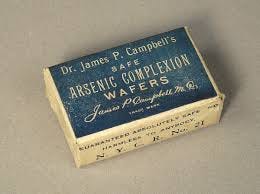
In 1890, Dr. James P. Campbell began selling arsenic complexion wafers.
They were advertised as “perfectly harmless.”
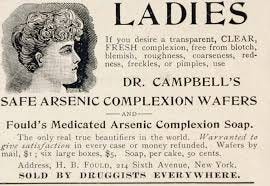
Women could purchase them from the Sears & Roebuck catalogue or their local druggist. The wafers—small, white, chalky things meant for “delicate nibbling”—promised to clear freckles, banish pimples, and produce the luminous, near-translucent pallor that fashionable society demanded. Women ingested them. They rubbed arsenic soap into their skin. In Bohemia, women bathed in arsenic-laced hot springs to lighten their entire bodies.
And some of them used the same substance to kill.
The problem for investigators was simple and devastating—arsenic was everywhere. Not just on vanity tables. A pigment called Scheele’s Green, a copper arsenite compound invented by a Swedish chemist in 1775, had become the must-have color for fashionable interiors. By the 1850s, one manufacturer estimated that one hundred million square miles of arsenical wallpaper covered the walls of British homes. The green dye flaked into dust, was inhaled, and in damp conditions produced a toxic gas. Children wasted away in nurseries papered with it. In 1862, four siblings in the Limehouse district of London died in a room decorated with Scheele’s Green—their symptoms initially mistaken for diphtheria.
When Queen Victoria learned that a visiting dignitary had fallen ill in a room with green wallpaper at Buckingham Palace, she ordered every room in the palace stripped of arsenical paper immediately.
Arsenic was also in food coloring, in fabric dyes, in mourning gowns. A widow might wear a black dress dyed with arsenic for months or years, the poison seeping through her skin while she grieved. When someone collapsed at the dinner table, arsenic was so commonplace that proving intent was nearly impossible. A woman with a packet of complexion powder was indistinguishable from a woman with a packet of poison.
Which, of course, is exactly what made it so useful.
What fascinates me as a mystery writer is not the poison itself. It is the context that made the poison invisible.
The ideal Victorian complexion was deathly pale—so pale it mimicked the translucent skin of tuberculosis patients. Consumption was romanticized in certain affluent circles. Wasting away was considered alluring. Women dropped belladonna—deadly nightshade—into their eyes to dilate their pupils, risking blindness for a wide, dark gaze that suited the romantic ideal. They rubbed mercury into their eyelids to encourage eyelash growth, as recommended by an 1874 Harper’s Bazaar beauty column called “The Ugly Girl Papers.”


